
Human oral antiparasitic pharmacology
How Does Ivermectin Work Against Susceptible Parasites?
How does ivermectin work? In susceptible invertebrates, it binds to glutamate-gated chloride channels in nerve and muscle cells, increases chloride movement across the membrane, and disrupts normal signaling. The resulting hyperpolarization impairs movement and survival. The mechanism is selective, but it is not universal across every organism or every life stage.
This page explains the human oral medicine’s antiparasitic action and its boundaries. It does not claim antiviral activity, select an indication, set a dose, or turn a molecular mechanism into a treatment promise.

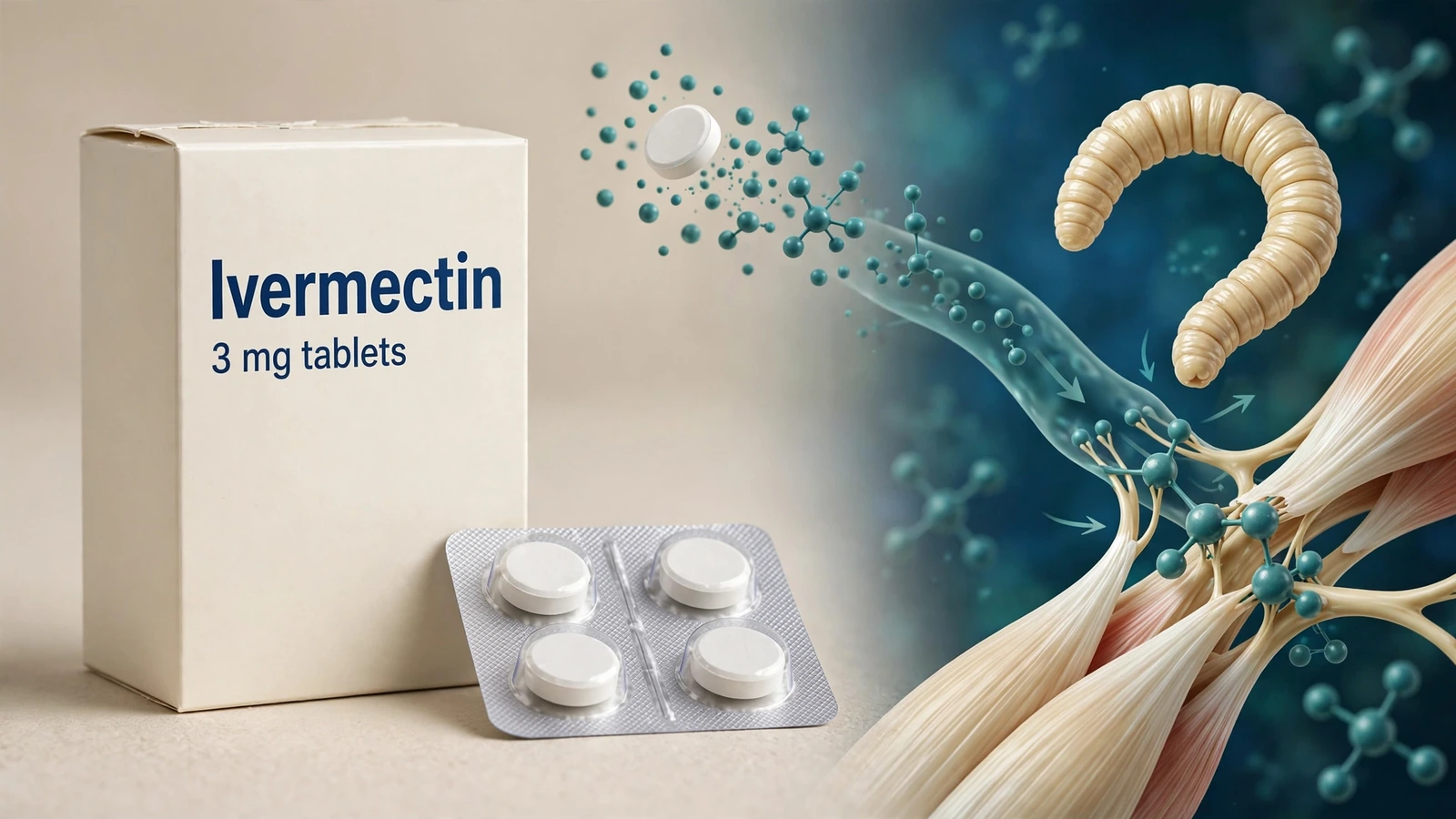
How does ivermectin work at parasite ion channels?
The current DailyMed label for the human oral tablet describes ivermectin as an avermectin-class antiparasitic medicine. Its principal labeled mechanism involves glutamate-gated chloride channels, which occur in invertebrate nerve and muscle cells. Binding changes the cell membrane’s permeability to chloride ions.
Ivermectin reaches a susceptible invertebrate channel.
High-affinity binding favors chloride movement.
The membrane becomes hyperpolarized.
Nerve and muscle activity is impaired.
Hyperpolarization makes the affected cell less able to generate the electrical changes needed for ordinary signaling. At the parasite level, this contributes to paralysis and death of susceptible stages. The word susceptible is essential because drug activity depends on the organism, the life stage, tissue location, exposure, and clinical setting.
The label also notes that ivermectin may interact with other ligand-gated chloride channels. Mechanistic detail does not provide a patient-facing calculation. It explains why a drug can affect a parasite; diagnosis and clinical evidence still determine whether that effect is relevant to the person in front of the clinician.
How does ivermectin work selectively?
Glutamate-gated chloride channels of the type central to this mechanism occur in invertebrates rather than mammals. The label further explains that mammalian ligand-gated chloride channels are generally found within the central nervous system and that ivermectin does not readily cross the human blood-brain barrier. These distinctions help explain the therapeutic separation between a susceptible parasite target and ordinary human nerve or muscle signaling.
That separation is not a declaration that adverse neurologic effects cannot occur. Current labeling includes postmarketing reports of altered consciousness, confusion, disorientation, stupor, coma, and death in people with and without onchocerciasis. A mechanism can be selectively useful while the medicine still requires prescription controls, contraindication screening, interaction assessment, and symptom monitoring.
Safety depends on more than the target channel. Absorption, metabolism, other medicines, a patient’s health record, the infection itself, and inflammatory responses to dying parasites can all contribute to what happens after treatment. Molecular selectivity should never be rewritten as “safe for everyone.”
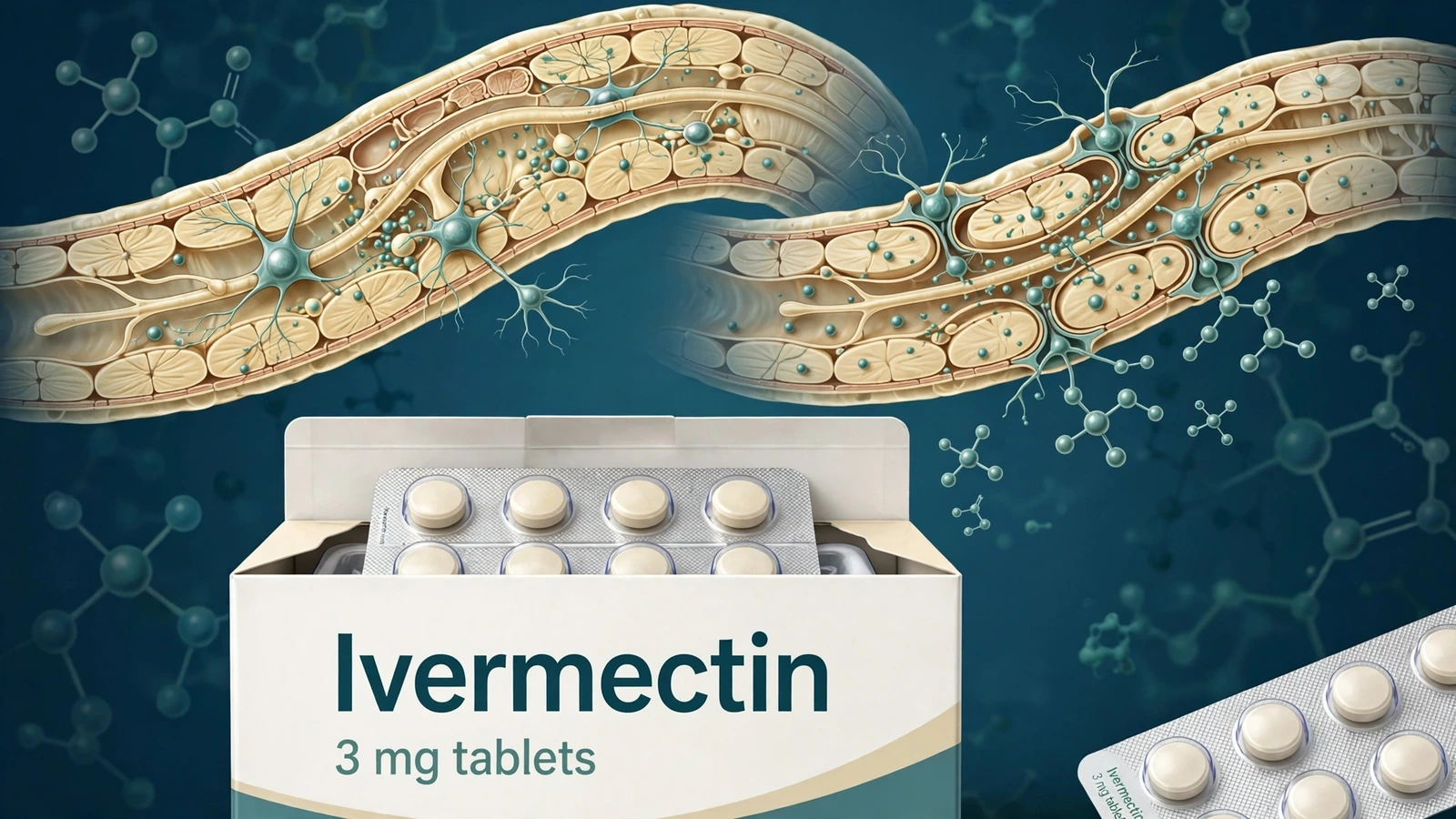
Life-stage limits change the clinical result
Strongyloides stercoralis
The human label describes activity against intestinal stages of this nematode. It does not reduce strongyloidiasis to a universal one-step cure. Larval output can be intermittent, severe disease changes management, and follow-up testing may be needed when prior stool evidence and symptoms persist.
Onchocerca volvulus
Ivermectin acts against tissue microfilariae but not adult worms living in subcutaneous nodules. Adult worms can continue producing microfilariae, which helps explain why onchocerciasis care may involve repeated assessment and treatment decisions over time.
This stage specificity is a direct answer to a common misconception. A drug can work against one biologic stage without eliminating the organism’s entire life cycle. Clinical success is therefore measured with condition-specific evidence, not by assuming that a well-described channel effect guarantees eradication.
The CDC’s Strongyloides clinical care recommendations connect treatment to diagnostic status, immune suppression, severe disease, and follow-up. The CDC’s onchocerciasis treatment page states the microfilariae/adult-worm distinction and adds the critical Loa loa co-infection precaution. Together, these official sources show why a mechanism page must remain subordinate to diagnosis.
From an oral tablet to a parasite target
After oral administration, ivermectin enters systemic circulation and is primarily metabolized by CYP3A4 according to in-vitro studies described in the label. Ivermectin and its metabolites are excreted mainly in feces. These pharmacokinetic facts explain how an oral medicine can reach systemic parasite targets, but they do not allow a reader to infer an individual dose or predict a treatment outcome.
Food, illness, absorption problems, body weight, and the exact product directions can affect the real clinical context. The prescriber and pharmacist use the approved label, diagnosis, and patient record rather than extrapolating from a mechanism illustration. A person with ileus, obstruction, or suspected malabsorption may need specialist management because standard oral treatment may not be reliable.
Similarly, knowing that CYP3A4 participates in metabolism does not create a complete interaction list. Laboratory metabolism findings and postmarketing reports have different levels of evidence. A safe medication reconciliation includes every prescription, nonprescription product, vitamin, supplement, and herbal product, followed by a clinician’s assessment of the full combination.
What the mechanism does not establish
- It does not diagnose a parasitic infection.
- It does not prove susceptibility in every species.
- It does not remove every parasite life stage.
- It does not select a personal regimen.
- It does not predict symptom resolution.
- It does not replace follow-up evidence.
A mechanism diagram is especially vulnerable to overstatement because it makes a complex process look linear. In the body, immune response, parasite burden, tissue distribution, co-infection, and ongoing adult-worm production can complicate the result. Those factors do not negate the mechanism; they define its clinical boundaries.
Prescription, contraindication, and adverse-effect boundaries
The human oral tablet is a prescription medicine. It is labeled for specific systemic parasitic infections, not for self-directed treatment of an unexplained symptom. The label contraindicates use in a person hypersensitive to a component. CDC condition pages add relative cautions around pregnancy, breastfeeding, low body weight, immune suppression, and possible Loa loa co-infection.
Medication reconciliation matters even on a mechanism page. The label notes postmarketing increased INR reports with warfarin and describes primary CYP3A4 metabolism in vitro. Neither statement authorizes a patient to stop or rearrange a medicine. They support direct coordination with the prescriber, pharmacist, and anticoagulation clinician when relevant.
Reported effects include gastrointestinal symptoms, dizziness, itching, rash, urticaria, fatigue, and condition-specific inflammatory reactions. In onchocerciasis, killing microfilariae can contribute to swelling, fever, rash, lymph-node symptoms, and blood-pressure changes. The cause and urgency depend on the symptom pattern and treatment context.
Common mechanism mistakes
One mistake is equating “antiparasitic” with activity against all parasites. Another is treating paralysis of a susceptible stage as proof that adult infection has ended. A third is assuming that a molecular target can confirm the cause of a person’s symptoms. Each shortcut removes the diagnostic evidence that gives the mechanism clinical meaning.
It is also misleading to use the absence of the same channel in humans as a guarantee against toxicity. The approved label contains warnings and adverse reactions because real patients, infections, inflammatory responses, and drug exposures are more complicated than one channel comparison. Good explanation keeps both facts visible: selectivity supports therapeutic use, and prescription oversight remains necessary.
Why a molecular effect and a clinical outcome are not simultaneous
Channel binding occurs at the parasite level, while symptoms are produced by a wider system that includes parasite burden, tissue injury, inflammation, and the body’s recovery. A person can therefore have continuing symptoms even when susceptible parasites have been affected. The reverse can also occur: a person may feel better before testing establishes whether infection evidence has cleared.
In onchocerciasis, killing microfilariae can temporarily increase inflammatory symptoms, and adult worms remain outside ivermectin’s lethal target. In strongyloidiasis, intermittent larval output and immune status can complicate interpretation. These differences explain why follow-up uses condition-specific examinations rather than a universal symptom deadline.
The mechanism is most useful when it clarifies what must be measured next. It should never be used to promise when a rash, bowel symptom, or eye finding will resolve.
Evidence boundary
This page uses current DailyMed human prescribing information and the linked CDC condition pages. It cannot identify an infection, recommend a regimen, or promise a clinical result, and it does not replace patient-specific medical care.