

Clinician-supervised human oral treatment
Ivermectin Dosage and Safety: What Clinicians Must Check
Ivermectin dosage and safety depend on the diagnosed parasite, measured body weight, the exact human oral product, current medicines, co-infection risk, and the follow-up plan. A search result cannot combine those facts into an individual regimen. The prescription must identify the condition and directions, while clinical monitoring addresses risks that a tablet count cannot show.
This page explains the decision framework. It is not a calculator, does not recommend a dose, and does not cover access, pricing, topical preparations, or products made for animals.


Why ivermectin dosage starts with the indication
The current DailyMed label for the human oral tablet provides different weight-based frameworks for intestinal strongyloidiasis and onchocerciasis. That is the first reason a dose cannot be inferred from the drug name alone. The target organism, susceptible life stage, expected course, and treatment interval are not the same.
Measured weight is used because the labeled regimens are expressed in micrograms per kilogram. Yet weight does not establish the diagnosis, identify Loa loa exposure, detect a medicine conflict, or confirm that follow-up is possible. A mathematically correct tablet count can still be clinically wrong when the inputs describe the wrong disease or an incomplete health record.
Condition record
Evidence should support the specific parasite and clinical form. Strongyloidiasis can require a very different response when hyperinfection or dissemination is present. Onchocerciasis treatment must account for microfilariae, adult-worm persistence, and geographic co-infection risk.
Current body weight
The clinician uses a measured, current weight rather than a remembered estimate. The pharmacist then checks that the prescribed directions and tablet strength produce the intended amount without asking the patient to improvise a calculation.
Product identity
The label, route, strength, patient name, and directions must match the prescription. An ingredient name on an unrelated product is not enough, and a human prescription cannot be reconstructed from another formulation’s packaging.
Safety context
Pregnancy, breastfeeding, allergies, age and weight, neurologic history, immune suppression, exposure geography, other medicines, and prior reactions can change whether and how treatment proceeds.
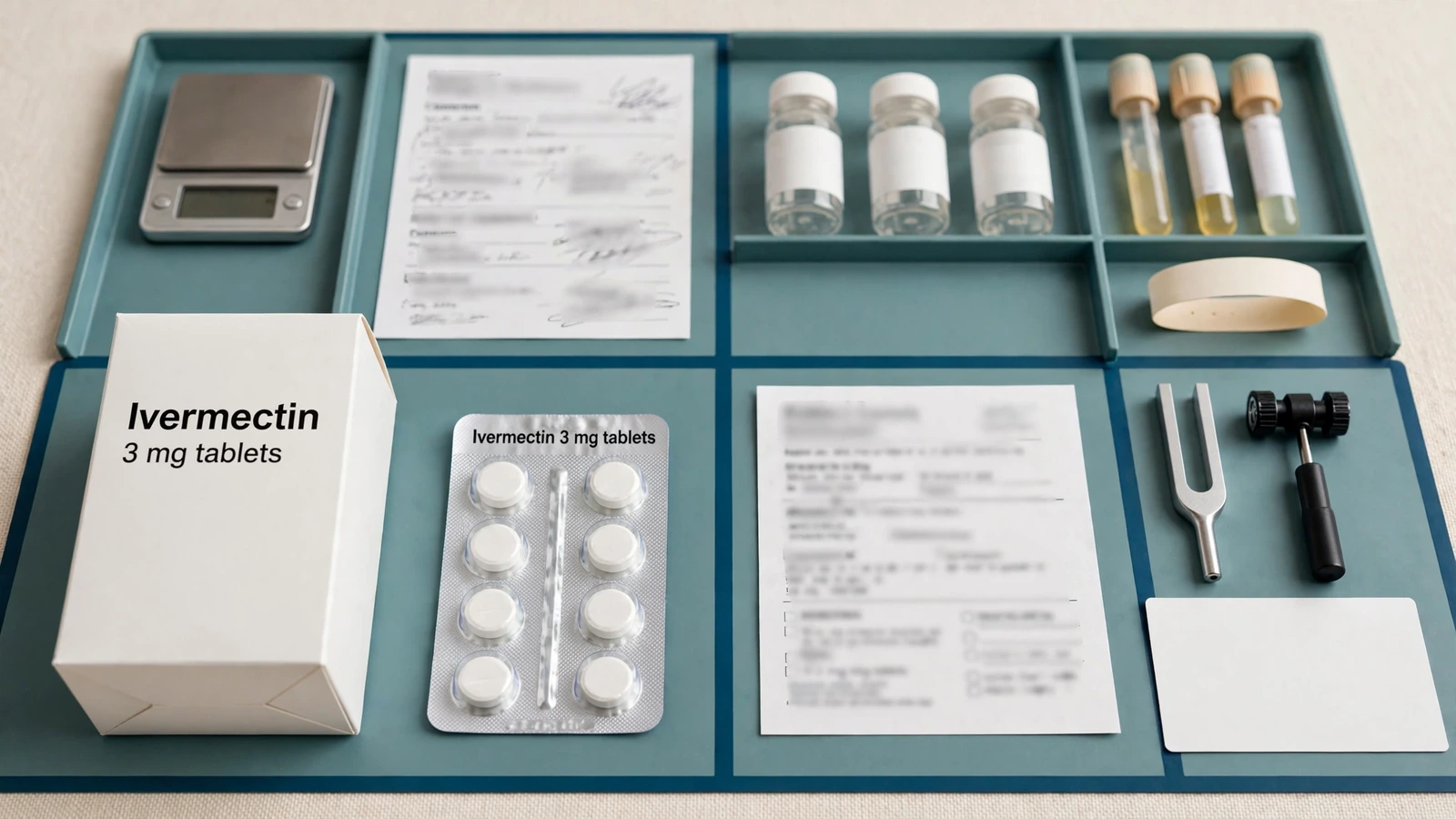
Six checks that shape ivermectin dosage
- Confirm the infection. Match symptoms and exposure to condition-appropriate testing rather than treating an unverified suspicion.
- Define the clinical form. Identify uncomplicated intestinal disease, severe Strongyloides illness, or onchocerciasis findings that change the care plan.
- Measure weight and match strength. Use a current measurement and the exact dispensed human oral tablet.
- Reconcile every medicine. Include prescriptions, nonprescription drugs, vitamins, supplements, and recently stopped products.
- Check individual precautions. Record hypersensitivity, pregnancy or lactation, low body weight, neurologic symptoms, and relevant travel or residence.
- Set follow-up before treatment. Decide which symptoms, examinations, or laboratory findings will trigger contact, repeat testing, or specialist input.
This sequence protects against a common shortcut: treating dose selection as a single multiplication problem. Clinical work happens both before and after the calculation. The page on factors used to determine an ivermectin dose examines those inputs without producing a personal result.
The treatment context changes follow-up
For uncomplicated strongyloidiasis, the CDC’s Strongyloides clinical care page places oral ivermectin within a condition-specific treatment plan and calls for follow-up stool examinations in patients who have a positive stool examination and persistent symptoms. Severe or disseminated disease is a different clinical situation, particularly when immunosuppressive therapy contributes to risk. It should not be reduced to the directions used for uncomplicated infection.
For onchocerciasis, the treatment target is tissue microfilariae rather than adult worms. The CDC’s onchocerciasis treatment recommendations explain why continued evidence of infection can lead to repeated treatment decisions and why possible Loa loa co-infection requires expert involvement. A person who remembers a prior tablet count cannot safely transfer it to a new interval or condition.
Follow-up also creates a safety net. Before the first dose, the patient should know which effects can be recorded, which symptoms require same-day contact, and which findings require emergency care. Without that plan, people may either dismiss a serious reaction or repeat medicine because expected symptoms have not resolved immediately.
Medication reconciliation is more than an interaction search
A full list should include prescription medicines, over-the-counter products, supplements, herbals, and recently discontinued treatment. The name, strength, schedule, reason for use, and prescriber or source help the clinician determine whether the list is current. A bottle photograph can help, but it does not replace directions or clarify whether the product is still being taken.
The official label notes postmarketing reports of increased international normalized ratio when ivermectin was used with warfarin. A report is not the same as a quantified interaction rate or proof of causation, but it is a reason for a patient taking warfarin to alert the prescriber and anticoagulation team rather than changing either medicine alone. The label also describes ivermectin as primarily metabolized by CYP3A4 in vitro. That fact supports careful reconciliation; it does not justify a universal list of forbidden combinations.
Interaction decisions may affect timing, monitoring, or whether another treatment is chosen. They should be made by the treating clinicians and pharmacist, particularly when a medicine has a narrow therapeutic range or the patient has new neurologic, bleeding, or blood-pressure symptoms. The dedicated page on ivermectin interaction and monitoring checks shows how to organize that record.
Contraindications, cautions, and adverse effects are different
| Category | Example from official sources | Operational meaning |
|---|---|---|
| Contraindication | Hypersensitivity to a component | Do not use that product |
| Relative caution | Pregnancy, lactation, or low weight | Weigh condition-specific risks |
| Exposure concern | Possible Loa loa co-infection | Obtain expert assessment |
| Expected monitoring | Gastrointestinal or skin symptoms | Record severity and course |
| Urgent warning | Seizure or altered consciousness | Seek emergency care |
These categories should not be flattened into “safe” or “unsafe.” A common effect can be uncomfortable without being an emergency, while a rare neurologic or allergic finding can require immediate action. In onchocerciasis, inflammatory responses to dying microfilariae can add another layer that depends on the infection rather than the tablet alone.
When to contact a clinician
Use same-day contact for pronounced dizziness or faintness, new swelling, worsening eye symptoms, persistent vomiting, marked weakness, new numbness, fever with a spreading rash, or another symptom that is escalating after treatment. The treating team can distinguish a medicine reaction, an infection-related inflammatory response, dehydration, or an unrelated problem more reliably when the timing and complete medicine list are available.
Routine questions still deserve a planned channel. Ask before repeating a dose, changing the interval, stopping another prescription, or substituting a different product. Write down the exact label directions and the question; do not rely on a screenshot that omits the patient, indication, and date.
Common mistakes around dose and safety
- Calculating from an estimated body weight.
- Ignoring the diagnosed parasite and clinical form.
- Copying directions from a prior prescription.
- Leaving supplements off the medicine list.
- Missing travel history relevant to loiasis.
- Repeating treatment before the planned follow-up.
Another mistake is assuming absence of a known interaction means absence of risk. The medicine history also reveals duplicate therapy, a recently stopped product, a condition that needs monitoring, or a symptom that began before ivermectin. Those details prevent the new treatment from being blamed for every later event while still allowing prompt action when timing points toward a reaction.
Continue with dosage and safety questions
When a clinician has established an indication and issued a prescription, continue to buy ivermectin online through a licensed pharmacy. For dosing and safety details, choose the question that matches your concern:
- The dose-factor page linked above explains verified inputs and product matching.
- Ivermectin side effects and warning signs separates monitoring from urgent care.
- The interaction page linked above organizes medicines, baseline risks, and follow-up.
Clinical source boundary
This page uses current DailyMed human prescribing information and the linked CDC clinical-care pages. It does not replace diagnosis, prescribe a regimen, or authorize a dose change; patient-specific instructions must come from the treating clinician and dispensing pharmacist.