
Human oral prescription decision
Ivermectin Dosage Factors That Shape a Human Oral Dose
Ivermectin dosage factors begin with the diagnosed parasite and a current measured weight, then add product strength, disease severity, absorption, pregnancy or breastfeeding, co-infection risk, medicines, and follow-up needs. The calculation is only one part of the decision. A clinician must verify the inputs and issue directions for the individual human oral prescription.
This page explains how the factors fit together. It intentionally provides no self-service dose, weight table, or result that could be copied into treatment.


Ivermectin dosage factors begin with the diagnosis
The current DailyMed human tablet label uses different weight-based targets for intestinal strongyloidiasis and onchocerciasis. It also describes different treatment and follow-up contexts. A tablet count copied from one indication can therefore be wrong for another even when the patient weighs the same.
Clinical form matters inside the diagnosis. Uncomplicated intestinal strongyloidiasis differs from hyperinfection or disseminated disease, which may involve prolonged treatment, impaired absorption, critical illness, and modification of immune-suppressing therapy. In onchocerciasis, the medicine affects microfilariae but does not kill adult worms, so continuing infection evidence can influence future treatment intervals.
The prescriber must also decide whether ivermectin is the appropriate medicine at all. An unexplained rash, diarrhea, itching, or travel history is not enough. Parasite-specific testing and the patient’s condition establish the framework before any calculation begins.
Why measured weight is one of the ivermectin dosage factors
Labeled dosing is based on body weight. A current measurement matters because remembered or rounded weights can shift the intended amount, particularly near a tablet-band boundary. The clinician documents the weight and target; the pharmacist checks the prescribed directions against the exact tablet strength being dispensed.
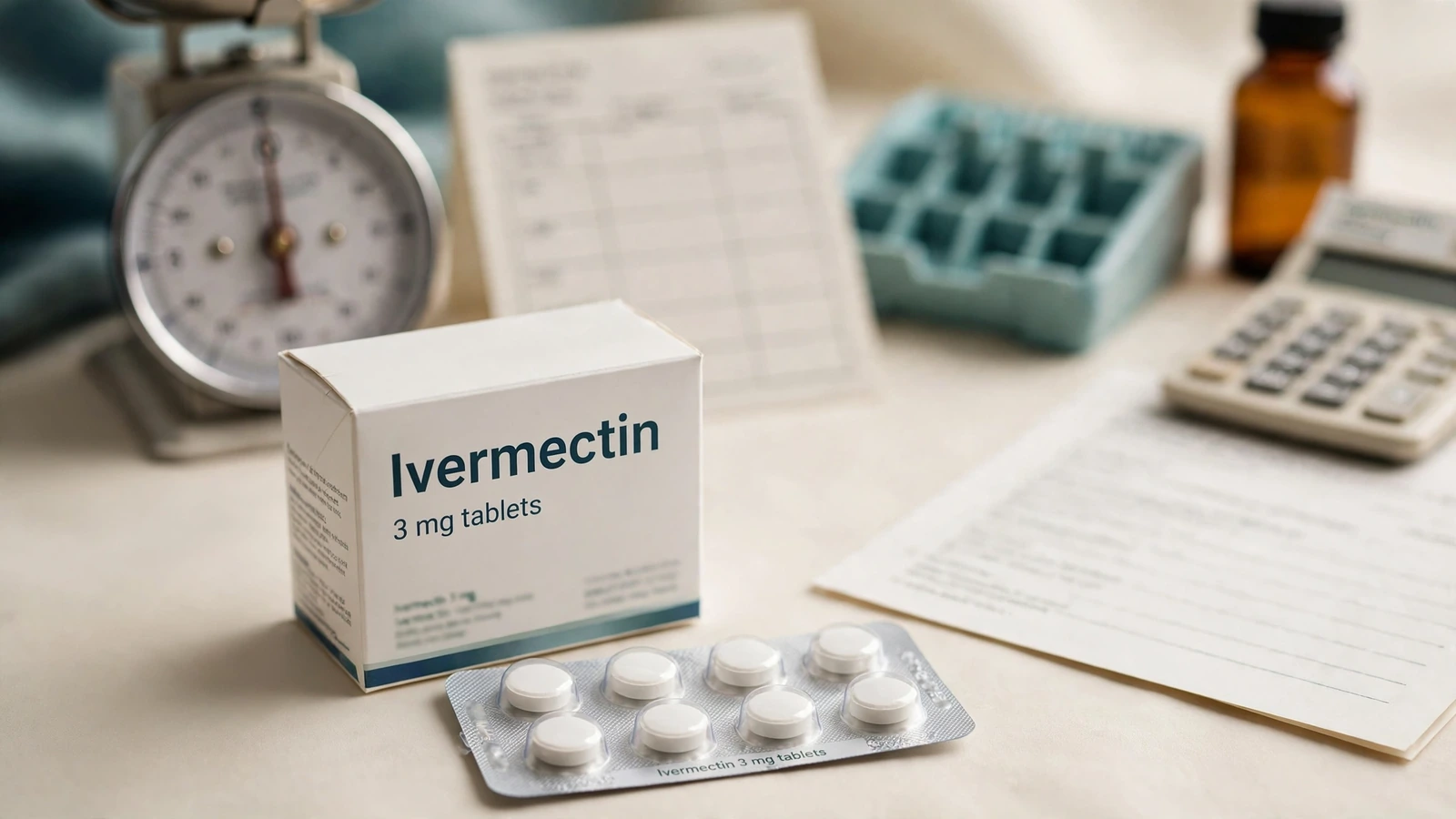
The label describes the brand tablet as a 3-milligram human oral tablet and supplies weight-band tables for its approved indications. That factual strength does not mean a reader should count tablets from body weight. The diagnosis, target amount, product, prescription, and clinical exceptions must all agree before a pharmacist prepares the medicine.
Children below the established weight threshold need a separate risk decision. CDC condition pages state that safety has not been demonstrated in children weighing less than 15 kilograms. Growth, swallowing ability, infection severity, and alternative care cannot be replaced by scaling an adult instruction.
Eight inputs belong in the same record
| Input | What must be verified | Why it changes the decision |
|---|---|---|
| Diagnosis | Organism and clinical form | Selects the regimen framework |
| Weight | Current measured value | Supports weight-based calculation |
| Product | Human oral label and strength | Prevents formulation mismatch |
| Exposure | Countries, regions, and timing | Identifies co-infection concerns |
| Immune status | Steroids, transplant, malignancy, HTLV-1 | Changes severe-disease risk |
| Medicines | Complete current and recent list | Surfaces interactions and monitoring |
| Absorption | Vomiting, ileus, obstruction, malabsorption | May make oral therapy unreliable |
| Follow-up | Testing, symptoms, and contact plan | Defines response and next action |
None of these rows is decorative. If the diagnosis is uncertain, the calculation lacks a target. If weight is estimated, the arithmetic rests on weak data. If the medicine list or exposure history is incomplete, a seemingly correct prescription may omit a meaningful safety issue.
Strongyloidiasis can change from an outpatient problem to severe disease
The CDC’s Strongyloides clinical care recommendations separate acute or chronic disease from hyperinfection and disseminated strongyloidiasis. Severe disease may be associated with corticosteroids or other impaired immunity and can involve gastrointestinal, pulmonary, neurologic, and systemic complications. Oral absorption may also be unreliable.
This is an edge case with major consequences. A person who has ileus, obstruction, malabsorption, or critical illness should not assume that a standard oral regimen will behave normally. CDC describes specialist and regulatory procedures used when ordinary oral administration is impossible. Those procedures are not equivalent to selecting a nonhuman formulation independently.
Follow-up is condition-specific as well. In a patient with positive stool evidence and persistent symptoms, CDC recommends repeat stool examinations after treatment. Findings, rather than symptom frustration alone, determine whether retreatment is considered.
Onchocerciasis adds life-stage and geography questions
The CDC’s onchocerciasis treatment page explains that ivermectin kills microfilariae but not adult worms. That distinction affects treatment intervals and the meaning of continuing nodules or infection evidence. The regimen is designed for a clinical goal that differs from intestinal strongyloidiasis.
Geographic exposure can also signal possible Loa loa co-infection. Heavy loiasis creates a risk of severe encephalopathy after a microfilaricidal medicine. A broad entry such as “Africa travel” is not enough; clinicians need the countries, regions, dates, and relevant symptoms to decide whether expert testing is required before treatment.
Inflammatory reactions after microfilariae die are another condition-specific factor. Swelling, rash, itching, fever, lymph-node symptoms, blood-pressure changes, or eye findings may need monitoring and supportive care. The prescriber sets expectations and a contact threshold before the dose is taken.
Medication and health history can change monitoring
Medicine reconciliation
List prescriptions, nonprescription products, vitamins, supplements, herbals, and recently stopped medicines. Include strength, schedule, reason for use, and the prescribing team when known.
Clinical cautions
Record allergy to product components, pregnancy, breastfeeding, low body weight, neurologic symptoms, liver concerns, immune suppression, and prior treatment reactions.
The label notes postmarketing reports of increased INR when ivermectin was used with warfarin. That does not quantify risk for every patient or prove causation, but it means a person taking warfarin should involve the prescriber and anticoagulation team. Changing either medicine without coordination may create a different hazard.
Ivermectin is primarily metabolized by CYP3A4 in vitro. This supports thoughtful reconciliation but does not create a simple prohibited-drug list. The clinician and pharmacist consider the evidence for each combination, the duration of treatment, the patient’s organ function, and whether symptom or laboratory monitoring is appropriate.
Contraindications and warning signs stop the calculation
The human label contraindicates the product for anyone hypersensitive to a component. Pregnancy, breastfeeding, low body weight, possible loiasis, severe illness, and impaired oral absorption require tailored decisions. A past uneventful dose does not remove a new contraindication or make current symptoms irrelevant.
Use same-day clinician contact for marked dizziness or faintness, new swelling, worsening eye symptoms, persistent vomiting, new numbness, fever with extensive rash, or another rapidly escalating symptom. Bring the exact medicine label, dose time, symptom timeline, and full medicine list.
Common calculation mistakes
- Using estimated instead of measured weight.
- Ignoring the infection’s clinical form.
- Counting tablets before matching the product.
- Copying a regimen from another indication.
- Leaving supplements off the medicine list.
- Skipping a planned follow-up test.
A self-calculation can be numerically neat and clinically unsafe. It cannot evaluate diagnosis quality, co-infection, absorption, immune status, an interaction, or whether the correct human oral product is available. Those are the reasons the output belongs on a prescription rather than in a web calculator.
Pharmacy verification follows the clinical calculation
After the prescriber chooses a regimen, the pharmacist checks that the patient, drug, human oral route, tablet strength, directions, quantity, and indication form a coherent prescription. A discrepancy is resolved with the prescriber. It is not corrected by asking the patient to infer the intended tablet count from a chart.
Counseling should make the instructions usable without broadening them. The patient needs to know when and how to take the exact dispensed product, what to do if vomiting or a missed dose occurs, which reactions require urgent help, and whom to call with a question. The pharmacist also checks the available medication profile against the list supplied by the patient.
At home, keep the medicine in its labeled container and separate it from older prescriptions. Do not combine leftover tablets to recreate a quantity or repeat a prior course. If the label, tablet appearance, or directions differ from what the clinician discussed, pause and contact the pharmacy before taking the medicine. Verification is the final safety step in dose determination, not an administrative formality.
Evidence used for this page
This page is limited to the current DailyMed human prescription label and the linked CDC clinical-care pages. It cannot calculate or prescribe an individual regimen, and it does not replace instructions from the treating clinician or dispensing pharmacist.