
Licensed Pharmacy Checklist for Spironolactone Fills
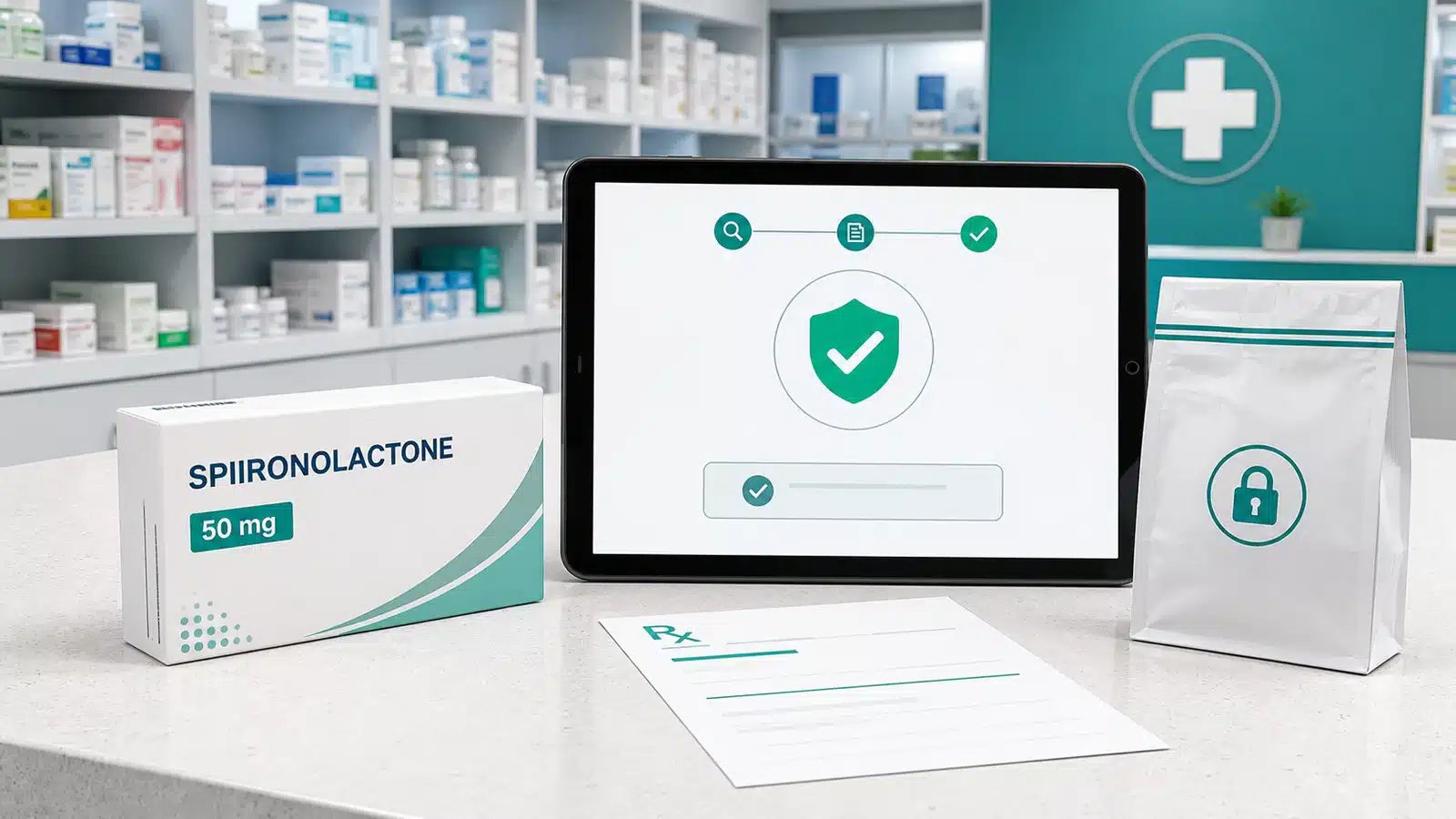
A licensed pharmacy checklist for spironolactone begins after a clinician has issued a valid prescription. Match the dispenser’s legal identity to an active state record, confirm pharmacist access, and compare the prescription label with the medicine supplied. A polished storefront or familiar product image cannot replace those checks.
Prescription care and pharmacy dispensing are connected, but they are not the same decision. The clinician determines whether spironolactone fits the acne pattern and the patient’s health history. The pharmacist verifies the prescription, checks the medication record available to the pharmacy, supplies the labeled product, and answers dispensing questions.
Pharmacy checks are one stage of spironolactone access after a prescribing decision, alongside insurance and out-of-pocket considerations.
Use a licensed pharmacy checklist for spironolactone before sharing information
An online storefront may use a trade name that differs from the legal name on a pharmacy license. It may also arrange care while a separate pharmacy performs the dispensing. Ask which legal pharmacy will place its name on the prescription label, then verify that business in the relevant state record. Checking only the telehealth brand can leave the actual dispenser unexamined.
The U.S. Food and Drug Administration tells consumers to look for a pharmacy that requires a prescription, provides a physical address and telephone number in the United States, offers access to a licensed pharmacist, and holds a state pharmacy license. These points work together. One reassuring detail does not cancel a missing license or a dispensing process that never requests the prescription.
| Checkpoint | Evidence to match | Place to confirm | Reason to pause |
|---|---|---|---|
| Legal identity | Business and pharmacy name | State license record | Name cannot be reconciled |
| License status | Active pharmacy credential | State board database | No active record appears |
| Physical contact | U.S. address and telephone | License and pharmacy site | Address details conflict |
| Prescription control | Valid prescription required | Dispensing intake | Medicine offered without one |
| Pharmacist access | Licensed pharmacist reachable | Published contact route | Sales staff answer only |
| Dispensed medicine | Drug, strength, directions, quantity | Label and prescription | Unexpected details remain |
Use the FDA’s state-license locator to reach the appropriate pharmacy authority rather than trusting a badge that links back to the seller’s own page. Michigan’s Department of Licensing and Regulatory Affairs also provides a public route for checking a licensed professional or business. When the dispensing state and delivery state differ, ask the relevant boards which records should be checked instead of assuming that one search settles every licensing question.
Licensure answers one question.
An active record supports that the named pharmacy is licensed under that authority. It does not establish that spironolactone is appropriate for a particular patient, that an insurance claim will be accepted, or that every statement on the storefront is accurate.
Stop when the identity stays unclear.
Do not send a prescription or health information until the dispensing business can be matched to a verifiable record and a pharmacist can be reached.
Apply the licensed pharmacy checklist for spironolactone in six decisions
- Name the dispenser. Obtain the legal pharmacy name that will appear on the label, not only the care platform’s brand.
- Match the record. Compare the legal name, address, credential type, and current status in the relevant state database.
- Call the pharmacy. Use the published telephone number and confirm that a licensed pharmacist is available for medication questions.
- Confirm the prescription. The pharmacy should require a valid prescription and enough patient information to dispense it accurately.
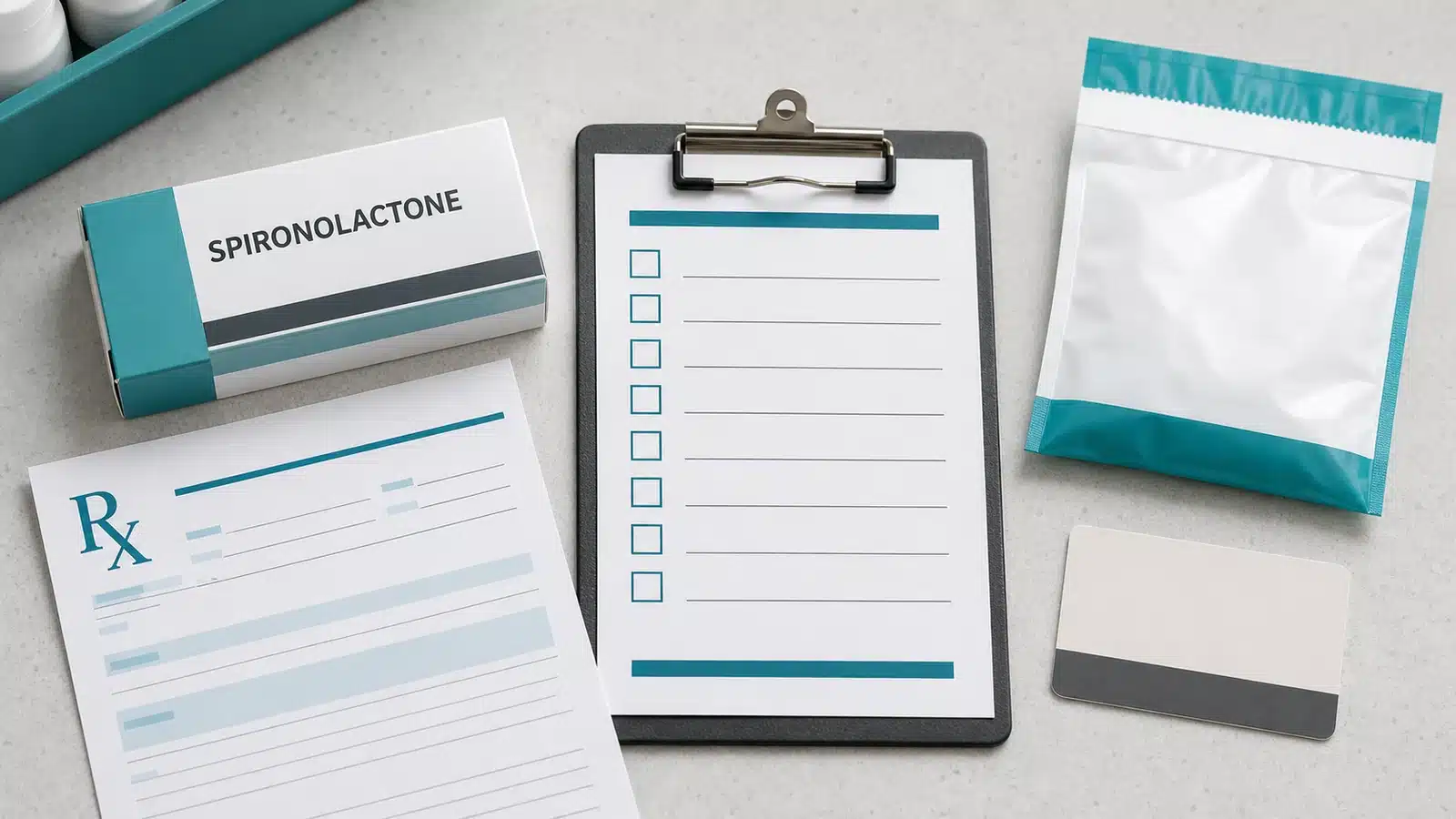
- Inspect the label. Check the patient, drug, strength, directions, quantity, prescriber, pharmacy, and refill information against the expected prescription.
- Resolve differences first. Keep the medicine unused until the dispensing pharmacist explains an unexpected tablet, bottle, manufacturer, label, or seal.
Similar pharmacy names and business structures can make this process less obvious than it sounds. A customer-service representative may identify the dispensing partner, but that statement still needs an independent record check. Save the legal name, license details, receipt, prescription label, and pharmacist contact together. Those records make it easier to resolve a paused fill, a changed manufacturer, or a question from the prescriber.
Check the prescription label before the first dose
A pharmacy label should let the patient identify what was dispensed and how it relates to the prescription. Compare the patient’s name, medicine name, strength, directions, quantity, prescriber, pharmacy contact, and any refill information. A manufacturer may change while the active ingredient remains the same, but the pharmacist should be able to explain that change and confirm the product.
Do not identify tablets from color or shape alone. Different manufacturers can produce products that look different, and an image found online does not authenticate the contents of a particular bottle. If the label, seal, packaging, tablet, or directions are not what you expected, keep the product aside and contact the dispensing pharmacist. The pharmacist can reconcile the National Drug Code, manufacturer, prescription, and pharmacy record.
Keep pharmacy verification separate from coverage
An active pharmacy license and a valid prescription do not guarantee that a health plan will process the claim without another step. A plan may use a preferred network, request documentation, apply formulary rules, or treat acne use differently from the drug’s labeled indications. These are coverage questions rather than proof that the pharmacy is legitimate.
If a claim pauses, ask the pharmacy for the exact rejection message and the name of the organization that made the coverage decision. After confirming the pharmacy’s identity and license, the cost and insurance factors to compare show why an advertised price may not be the final amount paid. Do not change the prescription or move health information to an unverified business merely because one claim did not process.
Medicine facts the pharmacy should not blur
Spironolactone is a prescription medicine. Its official U.S. label covers approved uses that do not include acne, while the American Academy of Dermatology’s acne guideline conditionally recommends spironolactone as a systemic acne therapy. That distinction matters: use for acne is clinician-directed and should not be presented as an automatic, FDA-approved acne indication.
The DailyMed prescribing information describes hyperkalemia and renal-function concerns, interactions with products that can raise potassium, and a pregnancy warning. A pharmacy should not tell a patient to ignore the prescriber’s monitoring plan or substitute a storefront questionnaire for a current medication list. Share prescription medicines, nonprescription pain relievers, supplements, salt substitutes, allergies, kidney history, and pregnancy context with the clinician and pharmacist.
Contraindications and interactions require the actual label and clinical record.
The prescribing information lists hyperkalemia, Addison’s disease, and concomitant eplerenone among contraindications. Potassium supplements and medicines that affect potassium or kidney function can change risk. The prescriber decides whether spironolactone belongs in the treatment plan; the pharmacist checks the prescription and medication record for dispensing concerns.
Warning signs that need medical help
Pharmacy verification cannot manage an adverse reaction. Contact the prescriber promptly for new weakness, persistent vomiting or diarrhea, marked dizziness, reduced urination, or other symptoms that could accompany dehydration, blood-pressure changes, kidney problems, or electrolyte disturbance. Seek urgent medical help for fainting, trouble breathing, swelling of the face or throat, severe confusion, or a fast or irregular heartbeat. Do not wait for an online seller to answer an urgent question.
Side effects that are not emergencies can still change the treatment plan. Report troublesome menstrual changes, breast tenderness, dizziness, or other new symptoms to the prescriber rather than changing the dose independently. If a pharmacist identifies a potential interaction or a label discrepancy, pause and let the prescriber and pharmacist resolve it together.
Reasons to end the transaction
- No valid prescription is required.
- No active pharmacy license can be matched.
- The legal name or address remains inconsistent.
- No licensed pharmacist is reachable.
- The product arrives damaged or unsealed.
- Label differences cannot be explained.
Other signals deserve the same caution: pressure to act immediately, requests for payment before the dispenser is identified, missing privacy terms, no route for medication questions, or claims that monitoring and contraindications do not matter. A legitimate process should make it possible to identify the pharmacy, verify its record, and speak with a pharmacist before the medicine is used.
Who this checklist is not for
- Someone seeking a prescription decision.
- Someone choosing a personal dose or schedule.
- Someone comparing sellers by discounts alone.
- Someone with symptoms requiring urgent care.
This material is educational and does not replace diagnosis, prescribing, state-board advice, or pharmacist counseling. It cannot verify a specific business for the reader, determine whether spironolactone is suitable, or confirm an individual insurance benefit.
Common Questions After a Prescription Is Issued
Does an active license prove that the medicine is right for me?
No. Licensure concerns the pharmacy’s authorization under the relevant record. The prescribing clinician decides whether spironolactone fits the patient’s acne and health history, while the pharmacist addresses dispensing and medication questions.
What if the care website and dispensing pharmacy have different names?
Ask for the legal name and location of the pharmacy that will appear on the label. Verify that pharmacy independently; checking only the care platform does not confirm the dispenser.
What if the tablets look different from the previous fill?
Keep them unused until the dispensing pharmacist confirms the active ingredient, strength, manufacturer, label, and prescription. Appearance alone cannot identify or authenticate the product.
Does a processed insurance claim replace a license check?
No. Coverage processing and pharmacy licensure answer different questions. Verify the pharmacy record even when a claim processes, and handle coverage problems through the plan, pharmacy, and prescriber.
Authoritative pharmacy and medicine sources
- FDA information on safer online pharmacy practices
- FDA state-licensed pharmacy locator
- Michigan Board of Pharmacy information
- Michigan professional and business license verification
- American Academy of Dermatology acne guideline
- DailyMed spironolactone prescribing information
External source links open the responsible agency or clinical organization. They do not endorse a particular dispensing business.