
Ovulation induction
Clomid for Ovulation Induction: How Clinicians Use It
Clomid for ovulation is used when a clinician identifies ovulatory dysfunction and decides that stimulating ovulation is an appropriate part of fertility care. Clomiphene changes estrogen feedback signaling, which can support gonadotropin release and follicle development. The mechanism does not establish candidacy, a personal schedule, or the likelihood of pregnancy.
Mechanism first, outcome second
The medicine is intended to address ovulation. It does not open blocked tubes, correct every uterine factor, resolve severe semen abnormalities, or guarantee that an ovulated egg will lead to pregnancy. A useful plan names the problem being treated and the separate factors that still require attention.
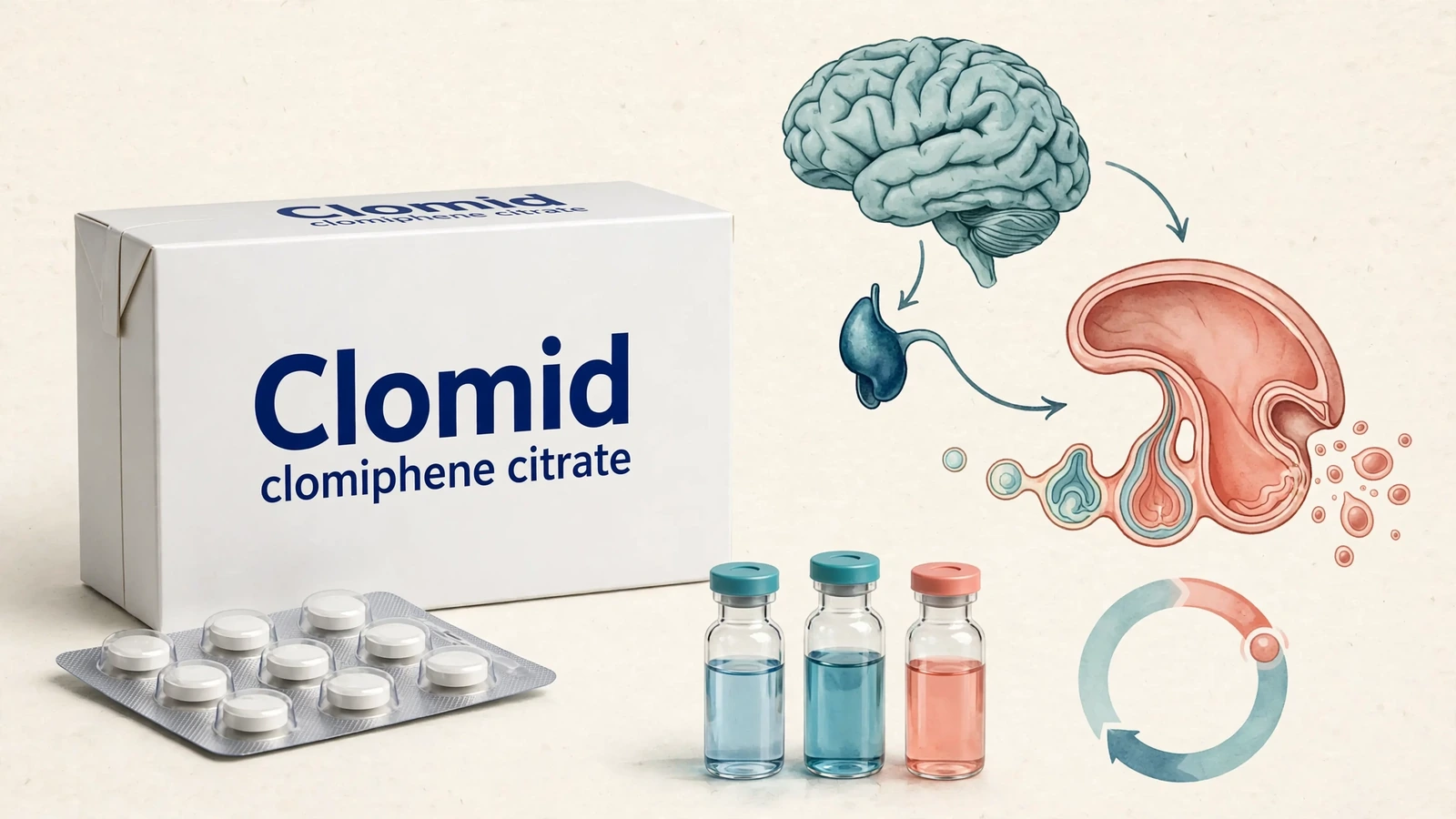
How Clomid for ovulation changes hormone signaling
The current DailyMed Clomid label describes clomiphene citrate as a nonsteroidal ovulatory stimulant and limits the approved indication to selected women with ovulatory dysfunction who desire pregnancy. The label also states that obstacles to achieving pregnancy should be excluded or adequately treated before therapy begins.
Clomiphene acts as a selective estrogen receptor modulator. In the hypothalamic-pituitary-ovarian signaling system, altered estrogen feedback can increase the hormonal signals that support follicle development. A follicle may then progress toward ovulation. This explanation is a mechanism, not a dosing instruction. The prescribed course and its timing must come from the individual label and prescriber.
Ovulation induction is therefore a controlled clinical experiment. The plan starts with a defined treatment target, uses an individualized prescription, watches for response and adverse effects, and ends with a decision. The decision may be to continue the approach, change it, investigate another factor, or stop. Repeating treatment without that decision removes the safety and diagnostic value of the cycle.
Evidence needed before an ovulation plan
Cycle pattern
Menstrual history can reveal a consistently regular pattern, irregular cycles, or absent periods. It is the starting point, not the only possible evidence.
Cause of anovulation
Thyroid, adrenal, pituitary, ovarian, medication-related, and other causes may require different management or further evaluation.
Other fertility factors
Reproductive-tract and male-factor assessment can change whether inducing ovulation is enough to move the plan forward.
Safety baseline
Pregnancy status, liver history, unexplained bleeding, ovarian findings, medications, and visual history belong in pre-treatment screening.
The ASRM fertility-evaluation committee opinion from 2021 explains that evaluation should be systematic and tailored to history. It lists menstrual history as a central ovulation assessment and describes selected tools that may be used when the pattern is uncertain or another question must be answered.
What monitoring after Clomid for ovulation can show
Monitoring may help determine whether ovulation appears to have occurred, how the ovaries responded, and whether symptoms require a change in care. Depending on the clinical question, a plan may use cycle history, ovulation tracking, laboratory testing, ultrasound, or a combination. More testing is not automatically better. Each test should have a reason and a planned response to the result.
An ovulation marker does not prove that every other fertility factor is favorable. It also does not establish pregnancy. Conversely, an unclear home test does not by itself show that treatment failed. Clomiphene can influence the hormone pattern that some tests are designed to detect. Interpretation belongs in the clinical context rather than in a single line on a chart.

PCOS is related but not interchangeable
PCOS is a common setting for anovulatory infertility, yet the phrase “Clomid for PCOS” describes a separate decision cluster. The 2023 international PCOS guideline compares treatment options and places them within candidacy, prior therapy, and risk considerations. A mechanism page should not flatten that choice into a single recommendation.
Someone with PCOS may need attention to irregular ovulation, metabolic factors, other infertility causes, and treatment-specific monitoring. Someone without PCOS may have ovulatory dysfunction for a different reason. The PCOS-specific Clomid page owns that diagnosis context; this page stays focused on hormone signaling and ovulation assessment.
Contraindications and reasons to pause
The DailyMed label contraindicates clomiphene during pregnancy and in people with liver disease or a history of liver dysfunction, unexplained abnormal uterine bleeding, or ovarian cysts or enlargement not due to PCOS. It also names uncontrolled thyroid or adrenal dysfunction and organic intracranial lesions such as a pituitary tumor. These are not boxes for a reader to clear alone. They are reasons the prescriber needs the complete history and current findings.
Medication reconciliation belongs in the same check. MedlinePlus advises telling the clinician and pharmacist about prescriptions, nonprescription products, vitamins, supplements, and herbal products. Even if a product is not named in a short interaction list, it can affect symptoms, laboratory interpretation, or the wider treatment plan.
Common mistakes in ovulation induction
- Assuming irregular periods prove one diagnosis
- Using a schedule copied from another person
- Treating ovulation as proof of pregnancy
- Repeating treatment without reassessing response
- Ignoring vision or abdominal symptoms
- Leaving other medicines out of the clinical history
A stronger plan documents the treatment target, the prescription instructions, how response will be judged, which symptoms trigger contact, and what happens if the result is unclear. This record is useful even when the cycle does not proceed as expected because it preserves the information needed for the next clinical decision.
Questions that are not answered by a dosing calendar
- What finding made ovulatory dysfunction the treatment target?
- Ask which history, test, or examination result supports the decision and which alternative causes were considered.
- What will change if ovulation is not confirmed?
- The answer should name the reassessment or next diagnostic question, not simply promise another course.
- Which symptoms should stop the planned sequence?
- Clarify instructions for visual changes, abdominal symptoms, bleeding, breathing changes, and other individual risks.
- How are other fertility factors being handled?
- Ovulation induction and broader fertility evaluation should be connected rather than treated as unrelated appointments.

Clinical subject-matter profile
Internal medicine, medication safety, and comparative evidence. This specialist profile provides subject-matter context; individual diagnosis and treatment decisions require direct clinical care.
Medical information notice: This page explains clomiphene labeling and fertility-care principles. It does not diagnose ovulatory dysfunction, provide a personal regimen, or replace a reproductive-health clinician.
What an ovulation result can and cannot answer
An ovulation marker can help show whether the intended hormone sequence occurred, but it does not by itself explain why pregnancy did or did not follow. Timing, sperm factors, tubal or uterine factors, age-related considerations, and other clinical findings may remain relevant. A result should therefore be tied to the original question rather than treated as a complete fertility outcome.
When a result is unclear, ask whether the uncertainty comes from collection timing, the method used, an incomplete cycle record, or a need to reconsider the diagnosis. Repeating treatment without resolving that uncertainty can add exposure without producing a clearer answer.
Prepare a cycle summary for the clinician
A useful summary is short but specific: the current prescription label, the dates medicine was actually taken, bleeding pattern, home-test dates, laboratory or ultrasound dates, symptoms, and any new medicine or supplement. Keep measured facts separate from interpretation. “Positive home test on this date” is more useful than “ovulation definitely happened.”
Also note which outcome matters at this stage. Some visits focus on whether ovulation occurred; others on safety, timing, or whether additional infertility evaluation is needed. The same test can carry different meaning depending on the decision it is supposed to support.
| Bring | Why it matters | Avoid concluding |
|---|---|---|
| Prescription and actual-use dates | Confirms the exposure being assessed | That a copied schedule applies |
| Tests and symptoms on one timeline | Preserves timing context | That one marker proves the full outcome |
| Next-decision question | Shows what the evidence must answer | That another course is automatic |
Key boundary: ovulation evidence informs a clinician’s decision; it does not create a personal schedule or guarantee pregnancy.