
What Happens at a Sleep Study, From Arrival to Results

A sleep study records what your body does overnight: breathing, oxygen levels, heart rhythm, brain activity and movement. It is painless, and nothing is inserted or injected.
It exists because several of the conditions that cause severe daytime sleepiness cannot be told apart from symptoms alone, and treatment depends entirely on which one you have.
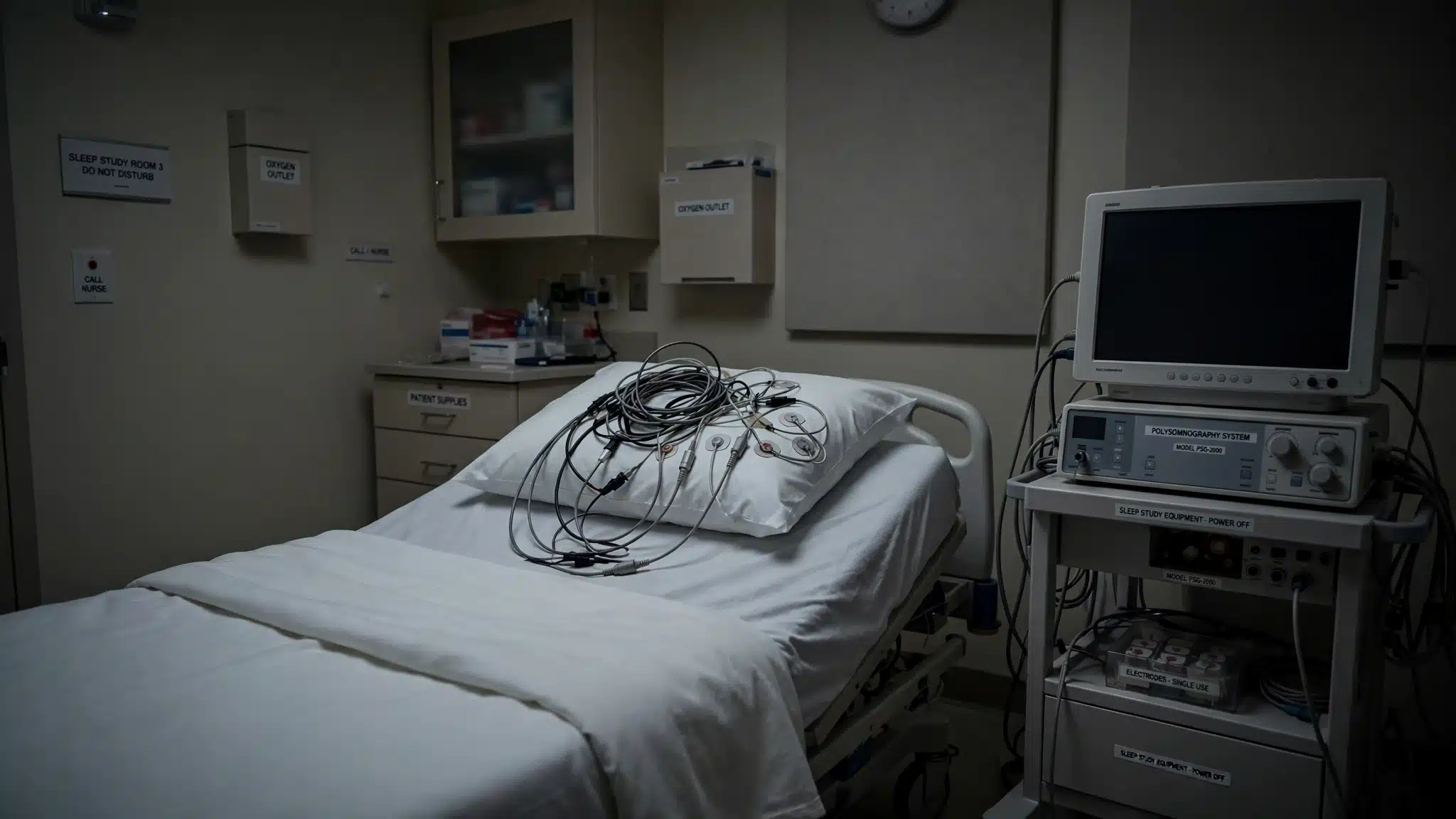
Sleep Study What to Expect Overnight in a Center?
You arrive in the evening and settle into a private room that is closer to a plain hotel room than a hospital ward. A technologist attaches sensors to your scalp, face, chest and legs with paste or tape, along with a clip on a finger and soft bands around the chest and abdomen.
Then you go to sleep. Someone monitors the recording from another room and can help if a sensor comes loose. Most people sleep worse than at home, and the study still works. It does not need a perfect night.
Sleep Study What to Expect at Home?
Home testing uses a smaller set of sensors and is used mainly where obstructive sleep apnea is the likely answer. It is more comfortable and more convenient, but it records less. If the result is unclear, or if something other than apnea is suspected, an in-center study usually follows.
Which Daytime Test Sometimes Follows?
Where narcolepsy or idiopathic hypersomnia is being considered, an overnight study may be followed by a daytime test made up of scheduled nap opportunities. It measures how quickly you fall asleep and what kind of sleep you enter. This is the test that distinguishes those conditions, and it is why the diagnosis cannot be made in a single consultation.
How Should You Prepare?
- Follow the center’s instructions on caffeine and alcohol, both distort the recording.
- Wash and dry your hair without conditioner or product, so sensors stick.
- Bring your usual nightwear, and your own pillow if it helps you settle.
- Bring a complete list of your medicines and ask in advance about anything you take at night.
- Plan how you are getting home, particularly after a daytime test.
Afterwards
Results are scored and interpreted rather than read off a screen, so they take time. What comes back is a diagnosis or its absence, and both are useful. A study that finds nothing has excluded several serious possibilities and redirects the search.
Keep a copy of the report. It is the document that treatment decisions and coverage requests are built on for years afterwards.
What to report without waiting
Contact your prescriber promptly if you develop a rash of any kind, chest pain, a fast or irregular heartbeat, breathlessness, or new agitation, low mood or thoughts of harming yourself. A rash means stopping modafinil and seeking medical advice the same day rather than waiting for your next appointment.
A sleep study is one diagnostic step within the broader evaluation of excessive daytime sleepiness. Before testing, it helps to review why a person can be tired despite sleeping enough; after diagnosis, the page explaining why modafinil is not a study drug sets an important treatment boundary.
If you have been told you need a sleep study
A consultation can explain which test suits your situation and what the result would change.
Medically reviewed by Dr. Sarah Mitchell, MD, FAAD, Board-Certified Dermatologist. Last updated Aug 17, 2026.